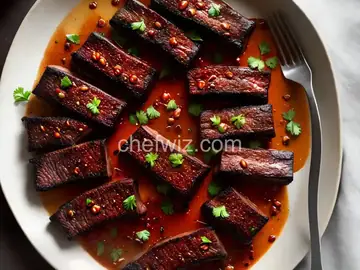
Traditional Beef Wellington
Rate this recipeBe the first to rate
 By AprilPublished
 Are you looking to impress your dinner guests with a show-stopping main course?
 By AprilPublished
 Are you looking to impress your dinner guests with a show-stopping main course?
Place the mushrooms in a food processor and blend until they reach a very fine consistency.
Heat a frying pan over medium heat. Add the mushrooms, a pinch of salt, and a pinch of pepper. Cook for about 5 minutes, or until the moisture evaporates and the mixture thickens. Transfer to a plate.
Lightly season the strip steak with salt and pepper. Heat a frying pan over high heat and add olive oil. Sear the steak on all sides for about 5 to 7 minutes, making sure not to overcook. Remove from the pan and baste with English mustard.
Take a large piece of plastic wrap and place the prosciutto on top, overlapping them in 2 rows of 4. Spread the mushrooms evenly over the prosciutto. Place the steak in the center and tightly roll the prosciutto around it. Wrap tightly in plastic wrap, twisting the ends. Chill in the refrigerator for 20 minutes.
Preheat the oven to 400 degrees F (200 degrees C) and line a baking sheet with aluminum foil.
Roll out the pastry sheet. Unwrap the chilled steak and place it in the center of the pastry. In a bowl, mix the egg and water to make an egg wash. Use a pastry brush to apply the egg wash to the edges of the pastry. Fold the pastry tightly around the steak and chill for 5 minutes.
Brush the remaining egg wash
Are you looking to impress your dinner guests with a show-stopping main course? Look no further than the classic dish known as Beef Wellington. With its tender beef filet, savory mushroom duxelles, and flaky puff pastry, this dish is a culinary masterpiece. In this article, we will explore the origins of Beef Wellington, the key ingredients, and the step-by-step process to create this delectable dish.
Beef Wellington is a traditional British dish that dates back to the early 19th century. It is believed to have been named after Arthur Wellesley, the 1st Duke of Wellington, who was known for his love of fine food. The dish gained popularity in the United Kingdom and later became a staple in high-end restaurants around the world.
Beef Wellington consists of several key ingredients that come together to create a harmonious blend of flavors and textures. Let's take a closer look at each component:
The star of the show, the beef filet is the centerpiece of Beef Wellington. It should be of the highest quality, tender and flavorful. The filet is seared to perfection before being wrapped in the other ingredients.
A rich and earthy mixture of finely chopped mushrooms, shallots, garlic, and herbs, the mushroom duxelles adds a depth of flavor to the dish. It acts as a barrier between the beef and the puff pastry, preventing the pastry from becoming soggy.
The puff pastry is what gives Beef Wellington its signature golden and flaky crust. It is carefully wrapped around the beef and mushroom duxelles, creating a beautiful and impressive presentation.
Prosciutto, a thinly sliced cured ham, is often used to wrap the beef filet before adding the mushroom duxelles. This adds an additional layer of flavor and also helps to keep the beef tender and juicy.
Creating a traditional Beef Wellington may seem daunting, but with careful preparation and attention to detail, you can achieve culinary greatness. Here is a step-by-step guide to help you along the way:
Start by finely chopping mushrooms, shallots, and garlic. Sauté them in butter until they release their moisture and become golden brown. Add herbs, such as thyme and parsley, for an extra burst of flavor. Allow the mixture to cool completely.
Season the beef filet with salt and pepper. Heat a skillet with oil until it is smoking hot. Sear the filet on all sides until it develops a nice crust. This step helps to seal in the juices and adds flavor to the final dish.
Roll out the puff pastry on a lightly floured surface. Spread a layer of the mushroom duxelles onto the pastry, leaving space to wrap the beef filet. Place the seared beef filet on top of the duxelles and wrap the pastry around it, sealing the edges tightly.
Transfer the wrapped beef filet onto a baking sheet lined with parchment paper. Brush the pastry with beaten egg for a glossy finish. Bake in a preheated oven until the pastry is golden brown and the internal temperature of the beef reaches your desired level of doneness.
Once the Beef Wellington is cooked to perfection, allow it to rest for a few minutes before slicing. This will ensure that the juices redistribute and the flavors meld together.
Beef Wellington is a true culinary masterpiece, combining tender beef filet, savory mushroom duxelles, and flaky puff pastry. It is a dish that is sure to impress even the most discerning of palates. So why not channel your inner chef and give this classic recipe a try? Your taste buds will thank you.
A1: While the traditional cut for Beef Wellington is a filet, you can experiment with other cuts such as sirloin or ribeye. Just make sure to adjust the cooking time accordingly.
A2: While it is best to serve Beef Wellington immediately after baking, you can prepare the components in advance and assemble them just before baking to save time.
A3: Beef Wellington pairs well with a variety of side dishes such as roasted potatoes, steamed vegetables, or a fresh green salad.
A4: Absolutely! You can replace the beef filet with a hearty vegetable, such as roasted butternut squash or portobello mushrooms, and follow the same steps for assembling and baking.
A5: While it is possible to freeze Beef Wellington before baking, the quality may be compromised. It is best to enjoy it fresh.
A6: The internal temperature of the beef will vary depending on your preferred level of doneness. Use a meat thermometer to ensure it reaches the desired temperature.
A7: Yes, you can make individual Beef Wellingtons by using smaller cuts of beef and adjusting the cooking time accordingly.
A8: Absolutely! A classic red wine reduction or a creamy mushroom sauce would complement the flavors of Beef Wellington perfectly.
AprilCook, recipe developer and the heart of Chefwiz. More about April