Never-Ever-Fail Meringue
Rate this recipeBe the first to rate
 By AprilPublished
 Have you ever dreamed of creating a light and fluffy meringue that melts in your mouth?
 By AprilPublished
 Have you ever dreamed of creating a light and fluffy meringue that melts in your mouth?
In a saucepan, combine cornstarch and cold water, then mix well.
Pour boiling water into the saucepan and cook the mixture until it thickens and becomes clear.
Allow the mixture to cool completely.
In a separate bowl, beat the egg whites until they become foamy.
Gradually add sugar to the beaten egg whites, continuing to beat until the mixture becomes stiff and glossy.
Add salt and vanilla to the mixture, then slowly incorporate the cold cornstarch mixture while continuously beating.
Beat the mixture quickly for several minutes.
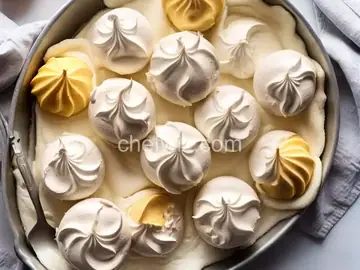
Spread the meringue evenly on top of a filled and cooled 9-inch pie.
Preheat the oven to 350 degrees F (175 degrees C).
Bake the pie in the preheated oven for about 10 minutes or until the tips of the meringue start to brown.
Have you ever dreamed of creating a light and fluffy meringue that melts in your mouth? Well, look no further! In this article, we will guide you through the process of making a never-ever-fail meringue. Whether you're a novice baker or a seasoned pro, this recipe is sure to impress.
Before we dive into the recipe, let's take a moment to appreciate the magic of meringue. Just think about it - this delicate sweet treat is made from the simplest of ingredients: egg whites and sugar. Yet, with a little bit of love and technique, these two humble ingredients transform into a cloud-like confection that can elevate any dessert to new heights.
So, how does it work? The key is in the whipping process. When you beat egg whites, you introduce air into the mixture. The proteins in the egg whites then form a network that traps these air bubbles, creating a stable foam. Adding sugar to the mix helps stabilize the structure and adds sweetness to balance out the natural acidity of the egg whites.
Now that we understand the science behind meringue, let's dive into some tips and tricks to ensure your meringue turns out perfect every time:
Before you begin, make sure all your equipment is clean and free of any grease or residue. Any trace of fat can hinder the foaming process, so be diligent in your preparation.
Using room temperature eggs is crucial for achieving maximum volume. Cold eggs take longer to whip and may not reach their full potential. So, let your eggs sit at room temperature for about 30 minutes before you begin.
When adding sugar to your egg whites, do it gradually. Adding it all at once can deflate the foam and result in a dense meringue. So, take your time and add the sugar in small increments while you continue to whip.
Adding a pinch of cream of tartar to your egg whites can help stabilize the meringue. This acidic ingredient helps the proteins in the egg whites coagulate and form a stronger structure. If you don't have cream of tartar, you can also use lemon juice or vinegar as a substitute.
Whipping meringue takes time, so be patient. Start on low speed and gradually increase as the foam forms. Avoid overbeating, as this can result in a grainy texture. When your meringue forms stiff peaks and holds its shape, you know it's ready.
And there you have it - the secrets to creating a never-ever-fail meringue. With a little practice and a lot of love, you'll be whipping up airy clouds of sweetness in no time. So, go ahead and give it a try! Your taste buds will thank you.
While it's not ideal, you can still make meringue in a humid environment. Just be aware that the excess moisture in the air can make it more challenging to achieve the desired texture and stability. Try to work quickly and avoid making meringue on a rainy or humid day.
Absolutely! A hand mixer works just as well as a stand mixer. Just make sure to use a large bowl to give yourself enough room to whip the egg whites properly.
If you have any leftover meringue, store it in an airtight container at room temperature. Avoid refrigerating it, as the moisture in the fridge can cause the meringue to become soft and lose its crispness.
Yes! You can add various flavorings to your meringue, such as vanilla extract, almond extract, or even a hint of citrus zest. Just be mindful of the amount you add, as too much liquid can affect the stability of the meringue.
There could be a few reasons why your meringue turned out flat. It's possible that there was residual grease on your equipment, or your egg whites were not whipped to stiff peaks. Additionally, overmixing or underbaking can also result in a flat meringue.
Yes, you can freeze meringue! Just make sure to let it cool completely before transferring it to an airtight container or freezer bag. When you're ready to use it, thaw it in the refrigerator overnight.
Absolutely! Meringue is incredibly versatile and can be piped into various shapes, such as kisses, nests, or even intricate designs. Just make sure to use a piping bag fitted with a star or round tip for best results.
Yes, meringue makes a delightful topping for pies, especially lemon meringue pie. Spread the meringue over the pie filling, making sure to seal the edges. Bake it in the oven until the meringue turns golden brown.
While it is technically possible to make meringue without sugar, it is not recommended. Sugar not only adds sweetness but also helps stabilize the meringue and create its characteristic texture. Without sugar, your meringue may not hold its shape or have the desired taste.
AprilCook, recipe developer and the heart of Chefwiz. More about April