Hummingbird
Rate this recipeBe the first to rate
 By AprilPublished
 Have you ever marveled at the sight of a hummingbird? These tiny creatures, no bigger than your thumb, possess extraordinary abilities that make them one of nature's wonders.
 By AprilPublished
 Have you ever marveled at the sight of a hummingbird? These tiny creatures, no bigger than your thumb, possess extraordinary abilities that make them one of nature's wonders.
Begin by placing rum cream liqueur, coffee liqueur, milk, and strawberry syrup into a blender.
Add a banana and crushed ice to the blender.
Blend the ingredients together until a smooth consistency is achieved.
Pour the blended mixture into glasses.
Serve and enjoy the drink.
Have you ever marveled at the sight of a hummingbird? These tiny creatures, no bigger than your thumb, possess extraordinary abilities that make them one of nature's wonders. In this article, we will explore the fascinating world of hummingbirds, their unique characteristics, and how they have captivated the hearts of bird enthusiasts around the globe.
Imagine a bird that can hover effortlessly in mid-air, fly backward, and change direction in an instant. That's the hummingbird for you! With their incredibly fast wing beats, which can exceed 80 times per second, hummingbirds are the acrobats of the avian world. Their wings move in a figure-eight pattern, allowing them to generate lift in both the upward and downward strokes. This remarkable adaptation enables them to hover in front of flowers, extracting nectar with their long, slender beaks.
Hummingbirds are highly specialized nectar feeders. Their long beaks and extendable tongues allow them to reach deep into flowers to access the sweet reward inside. As they feed, their tongues flicker in and out at an astonishing rate of up to 13 times per second. This rapid motion creates a vacuum-like effect, drawing nectar up into their mouths. It's like watching a tiny straw in action!
Despite their small size, hummingbirds have high-energy requirements. To fuel their rapid metabolism, they need to consume vast amounts of nectar daily. In fact, some species can consume up to twice their body weight in nectar every day! To supplement their diet, hummingbirds also catch insects on the wing, providing them with essential protein and other nutrients.
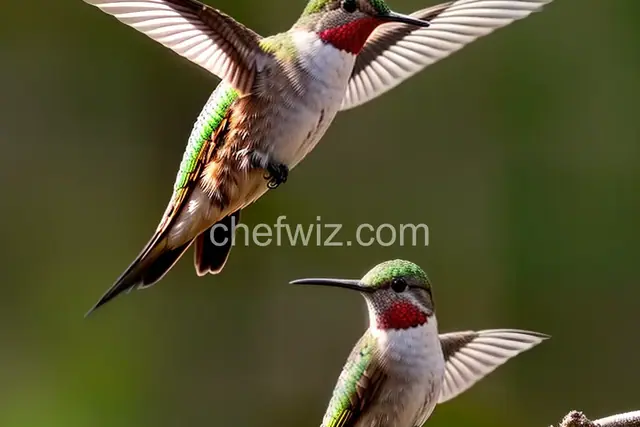
One cannot talk about hummingbirds without mentioning their vibrant plumage. These tiny birds come in a dazzling array of colors, from the brilliant reds and oranges of the Ruby-throated Hummingbird to the iridescent greens and blues of the Anna's Hummingbird. Their feathers contain microscopic structures that refract light, creating the illusion of ever-changing colors as they move. It's as if they carry a tiny rainbow with them wherever they go!
Despite their size, many hummingbird species embark on incredible migratory journeys. Some species travel thousands of miles each year, crossing vast stretches of land and sea. These journeys require meticulous planning and endurance, given the energy demands of their small bodies. It's truly remarkable how such tiny creatures can navigate across continents with precision and grace.
Hummingbirds are not just fascinating for their physical abilities; they also play crucial roles in ecosystems. As they flit from flower to flower, they inadvertently transfer pollen, aiding in plant reproduction. In essence, hummingbirds are nature's tiny gardeners, contributing to the diversity and beauty of the world around us.
Hummingbirds are truly remarkable creatures, defying expectations with their agility, vibrant colors, and migratory feats. They remind us that size is not a barrier to greatness, and that even the tiniest among us can have a profound impact on the world around them. So, the next time you catch a glimpse of a hummingbird, take a moment to appreciate the marvels of nature that flutter before your eyes.
Hummingbirds' wings can beat at an astonishing speed of over 80 times per second!
The iridescent feathers of hummingbirds serve to attract mates and deter rivals.
Some hummingbird species can consume up to twice their body weight in nectar every day!
Yes, many hummingbird species embark on long migratory journeys each year.
Hummingbirds navigate using a combination of visual landmarks, celestial cues, and an innate sense of direction.
Yes, hummingbirds are one of the few bird species capable of flying backward.
Hummingbirds use their long beaks and extendable tongues to reach deep into flowers and draw out nectar.
No, hummingbirds also catch insects on the wing, providing them with essential protein.
AprilCook, recipe developer and the heart of Chefwiz. More about April