Full Moon
Rate this recipeBe the first to rate
 By AprilPublished
 Have you ever gazed up at the night sky and been captivated by the luminous beauty of a full moon?
 By AprilPublished
 Have you ever gazed up at the night sky and been captivated by the luminous beauty of a full moon?
Combine the hot water, orange liqueur, almond liqueur, honey, and lemon juice in a glass.
Stir the mixture until well combined.
Add a lemon wedge and a few blueberries as garnish.
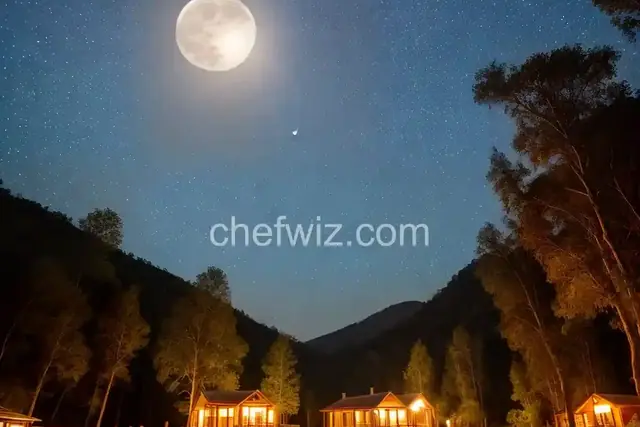
Have you ever gazed up at the night sky and been captivated by the luminous beauty of a full moon? The full moon, with its radiant glow, has fascinated humans for centuries. It has been the subject of myths, legends, and countless works of art. But what exactly is the full moon, and why does it hold such a powerful allure over us? Join me on a celestial journey as we explore the enigmatic phenomenon of the full moon.
At its core, the full moon is simply the lunar phase when the Moon appears fully illuminated from Earth's perspective. This occurs when the Moon is positioned directly opposite the Sun, with the Earth in between. The Sun's rays are fully reflected off the Moon's surface, creating a breathtaking spectacle for us to behold.
During a full moon, the Moon's face is fully visible to us, revealing intricate details of its surface. It is a time when the Moon shines its brightest, casting an ethereal glow upon the Earth. This celestial dance between the Sun, Earth, and Moon occurs roughly once every 29.5 days, marking the completion of a lunar month.
Throughout history, the full moon has held deep symbolic meaning in various cultures and belief systems. It has been associated with fertility, abundance, and the cycles of life. Many ancient civilizations worshiped lunar deities, attributing mystical powers to the full moon.
Metaphorically, the full moon has often been linked to illumination and enlightenment. Just as the full moon lights up the night sky, it is believed to illuminate our path, guiding us towards knowledge and self-discovery. It represents a time of introspection and inner growth.
While the full moon has captured our imagination, it has also been the subject of numerous myths and superstitions. Some believe that the full moon affects human behavior, leading to increased aggression or heightened emotions. Yet, scientific studies have failed to provide conclusive evidence supporting these claims.
However, one undeniable impact of the full moon is its influence on Earth's tides. The gravitational pull of the Moon, combined with that of the Sun, causes the tides to rise and fall. During a full moon, when the Moon and Sun are in alignment, we experience higher high tides and lower low tides, known as spring tides.
Whether you view the full moon as a mystical force or simply appreciate its celestial beauty, there are numerous ways to embrace its magic. Many cultures hold moonlit ceremonies and rituals during the full moon, celebrating its energy and significance.
One such practice is moon gazing, where individuals spend time in quiet contemplation under the moon's gentle glow. It is a moment to connect with nature, to reflect on one's own journey, and to find solace in the vastness of the universe.
The full moon, with its radiant presence, has mesmerized humanity for centuries. It is a symbol of beauty, mystery, and wonder. Whether you believe in its mystical powers or simply appreciate its celestial spectacle, the full moon continues to inspire awe and captivate our imaginations. So, next time you find yourself under a full moon, take a moment to bask in its enchanting glow and embrace the magic it holds.
The full moon can appear larger or smaller depending on its proximity to Earth. When the Moon is closest to us, it is called a supermoon and appears larger and more vibrant.
While some people claim to experience difficulty sleeping during a full moon, scientific studies have not found a significant impact on sleep patterns.
Despite widespread beliefs, scientific studies have not been able to establish a direct correlation between the full moon and changes in human behavior.
The full moon phase typically lasts for one night, but its illumination can be visible for a few days before and after the exact moment of fullness.
Various cultures and indigenous communities have assigned different names to each full moon of the year, often based on seasonal or agricultural events.
Some studies suggest that certain animal behaviors, such as increased nocturnal activity, may be influenced by the full moon, but more research is needed for conclusive evidence.
Unlike the Sun, it is safe to look directly at the full moon without any eye protection. Its gentle rays pose no harm to our eyesight.
Photographing the full moon can be a rewarding experience. Use a telephoto lens and a tripod to capture its mesmerizing details. Experiment with different exposure settings to achieve the desired effect.
AprilCook, recipe developer and the heart of Chefwiz. More about April